
THE CONVICT’S DAUGHTER
When Mother England decided to transfer her criminal element from the overcrowded gaols of home to the wide open spaces of Australia the powers to be who engineered this exodus obviously gave little thought to the birds and the bees.
Did they perhaps think the convicts they sent over in chains would not cohabit and reproduce? Did they feel any responsibility at all for the tiny innocents resulting from these unions? Did they actually care at all and wanted nothing more than to be rid of a growing problem and to hell with the consequences?
 |
First Fleet entering Botany Bay |
Apparently not, because no sooner had Captain Arthur Phillip offloaded his mixed cargo of male and female convicts onto the shores of Botany Bay in 1787 than the fun and games began, and nine months later little results began arriving, more mouths to feed, more bodies to clothe, more souls to shelter.
Trouble is of course these unfairly timed little bundles grew up in an atmosphere of utter despair and destitution; their parents, not all of them hardened criminals were faced with the same cruel punishment. Banishment from home. Life in a strange, harsh environment.
One of this growing number of youngsters whose birth certificate would be forever stamped with the words ‘Born in the Colony’ was my Great-Great Grandmother Catherine Spalding.
I’m very much afraid our little Catherine had a rough start in life.
You’ve met Catherine’s dad before, the Irishman from Mullingar in Westmeath County whose surname lurched between three or more aliases, Spollon, Spalden and Spalding. Eventually for Catherine and those of us who followed, the name Bryan Spalding was finally settled upon. Her mother was a woman known as Mary Welch, but with several convicts of the same name arriving at much the same time her background and heritage are really up for grabs. She could have been either English or Irish.
Two other Irishmen, a father and son alluded to in official records as being related to Bryan, had previously arrived in the Colony in 1793 on the Boddington. They were Francis Spalding, also known as Spalden, Spollen and Spillora age 60, and William Fanning aged 28, also known as Spalden and Spalding; all three men had been sentenced before the courts in Mullingar, Westmeath County. I believe William and Brian were brothers and Francis their father.
In Ireland’s long history the Spollen surname had many derivatives ranging from Spellan, O’Spealain and Spillain, and were to be found in parishes around Tipperary, Killaloe, Aglish, Tullagh and Inishcaltragh. Another coincidence when my Reluctant Traveller and I travelled around Ireland some years ago and spent two magical days looking for leprechauns in beautiful Killaloe on the shores of Lough Derg separating as it does the counties of Clare and Tipperary.

We travelled on a local bus from Limerick to Killaloe, the rain leaking through the roof, and stayed in a bed and breakfast close to the church. Had I but known the faces and places around me were images from my past.
________
There was a fourth Irishman who figured later in the Spalding story, who also received a life sentence in Westmeath. Thirty six year old Michael Minton arrived in New South Wales in 1800 on Hercules 1. His later death would put a 10 year old Catherine in the witness box of a Sydney court.
Yet another player in this story, a female convict Esther Nowlan or Knowland arrived on the same ship as Bryan Spalding. Esther had been tried in Dublin City and sentenced to 7 years transportation.
 |
Map of Ireland clearly shows Mullingar, Limerick, Dublin and Cork |
The Spalding men, all three of them, were Irish rascals but deeply committed to their homeland, which was probably one of the reasons they were transported to Australia. Irish nationals were a thorn in England’s side back then as they still are now.
Irish transportees were a class apart from England’s other convicts. Most if not all were rebels and defenders, their parents and grandparents had suffered for centuries under British misrule. They had seen their land and heritage taken from them along with their religion and their livelihood, and when these sons and daughters of Ireland had retaliated and fought back, they were punished with transportation to the ends of the earth. Australia.
I thought it a curious coincidence that the day Bryan Spollon and his fellow prisoners departed Cork Harbour in Ireland in 1796 on board Britannia 1, it coincided with my birth date, December 10th.
A few years after his arrival in Sydney Cove Bryan Spalding began living with the convict Mary Welch who arrived a little later in 1801 on the Nile 1. Her alias was given as Murphy, and though there were several female convicts with that name all were described as common thieves.
By the time Catherine was born in 1814 some of the basic comforts of life had been introduced to the small colony.
Adequate shelter for one thing, sufficient food for another.
Captain Phillip, who quickly morphed into Governor Phillip, swiftly sorted the colony out, sending ships off on long voyages to fetch additional food supplies from places like the port of Capetown in South Africa, and putting the convicts to work establishing vegetable gardens, albeit not always in the best and most productive sites.
He paved the way for successive Governors to build the colony from a tumble down sprawl into the thriving city it soon became.
 |
Capt. Arthur Phillip |
There again he had little choice. Beyond the point he landed, in all directions was unknown territory, a land that had known no white man’s occupation. Like most people of those times he was ignorant of the land's indigenous occupants. Captain Phillip and the people he brought with him across the sea would learn and survive far from the their homeland by a harrowing period of trial and error.
_______
Young Catherine escaped all the turmoil of those early years, but her life nevertheless was full of drama.
For a start, Mary the sister she thought was her older sister was actually her cousin, the daughter of William Fanning (Spalding), and his common law wife Esther Nowlan who had arrived on the same ship as Bryan Spalding in 1797.
William Fanning joined the militia soon after he arrived in the colony but died fifteen years later in 1807 on board the Government ship General Wellesley during a routine voyage to the penal colony on Norfolk Island.
According to New South Wales birth records, Mary was born in 1798 to William Spalden and Esther Knowland, and no doubt by her father’s death ten years later had been absorbed into his brother Bryan’s family... his common law wife Mary Welch, a son Charles and eventually young Catherine.
The entire family bar Catherine were rarely out of trouble with the law. No sooner had Bryan Spalding been given yet another ticket of leave then he inevitably again broke the law and his freedom was once more rescinded.
Bryan figured largely in the 1804 brief, but bloody uprising by Irish prisoners at Rouse Hill that resulted in the deaths of 30 rebels. As a consequence nine rebel leaders were hanged, seven were given between 200 and 500 lashes and 30 others were exiled to the Newcastle coal mines. Bryan , an emancipist at the time escaped the lash but lost his freedom...yet again.
Later, just a few years before his death he, his wife and his son Charles would appear in court on sheep stealing charges. The evidence against the three was overwhelming and the entire court including the three accused were amazed when they were acquitted on a slender but farcical legal technicality.
Mary Spalding went on to marry Michael Minton, an old mate of her step father Bryan Spalding. Minton’s first wife had been murdered in suspicious circumstances only a few short years before, and from all accounts Minton himself was a brutal and not very nice man to know. It seems strange that a much younger Mary had married him at all.
So it was no surprise that after two years of marriage he himself would be murdered in his own home in the presence of his wife, their two young children, Ellen and baby Michael, and his wife’s 10 year old sister Catherine Spalding.
Mary and two farm hands was charged with the murder, Catherine was called on to give evidence in the court during the lengthy hearing. The two farm workers were found guilty, but, according to newspaper reports at the time, the young and second Mrs Minton was inexplicably acquitted of the crime.
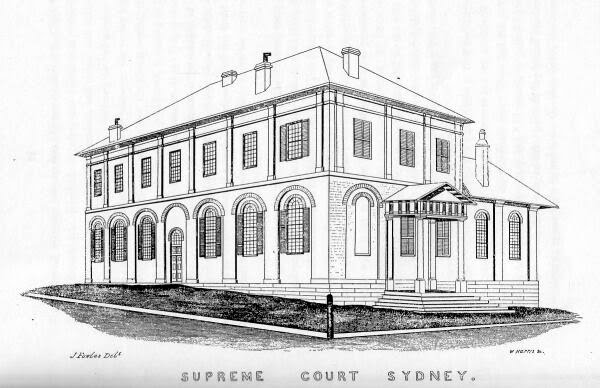
Architects drawing of the then 1828 Greenaway designed Supreme Court in Elizabeth Street Sydney where the Spalding’s no doubt felt quite at home.
_________
Catherine, just three years later at the age of 13 was sent to work as a servant in the residence of a wealthy and prominent grazier, Leslie Duguid.
Duiguid a recent arrival from England, became a founding director of the Commercial Banking Company of Sydney. He built a mansion in the Hunter Valley, Lochinvar House, where Catherine was employed as a junior maid. The house still exists.
 |
| Lochinvar House |
It must have been a relief when she met and married her future husband, Samuel Marshall five years later when she was 18 years old.
Young Catherine chose wisely. Her future husband had arrived in the colony on the convict ship Ocean in 1816 as a sixteen year old. He had been found guilty of larceny at Yorkshire’s Doncaster Quarter Sessions and sentenced to seven years imprisonment. He was only 14 years old when he committed the crime.
Once he arrived in the colony he was assigned to the explorer and settler John Howe. Howe together with Samuel and other ticket of leave convicts explored the Hunter Valley wilderness north of the colony, and young Sam was eventually rewarded by the authorities for his efforts with a grant of land.
The newly married Marshalls farmed the Black Creek and Patrick’s Plains area near Newcastle before taking up their 50 acre land grant. An early census of land owners describes Samuel as a horse breaker.
Samuel and Catherine lived a reasonably prosperous and law abiding life raising their six children. Both were openly sympathetic to the Irish cause with Samuel publicly donating to the Irish Relief Fund.
Catherine may have been the only law abiding member of the Spalding family but at the same time she grew into a feisty young lady who brooked no trouble from farm employees or passing vagabonds. An entry in Government records shows she took up arms to successfully defend herself and the farm stock when threatened by cattle duffers.
Samuel became a man of property. In 1840 he was the landlord of the Shamrock Inn at Anvil Creek when it was robbed by bushrangers. By 1847 the Marshall’s had established sheep and cattle runs on a property near Branxton, not far from Maitland. They had six children, four sons and two daughters.
And while her father Bryan may have been in and out of trouble for much of his life, his daughter never forgot her father, nor her humble beginnings as the ‘Born in the Colony’ daughter of a convict.
With the birth of their last son, Catherine insured the memory of her father and their Irish heritage by calling the child William Spalding Marshall.
___
Catherine (Spalding) Marshall, the Convict’s daughter, was my Grandmother Isabella (Marshall) Brown’s grandmother. She was my first Australian born relation.
Catherine died in Singleton in 1895 at the age of 80 years. She survived her husband Samuel by 25 years.
Catherine never moved all that far from the area around Anvil Creek where she and Samuel farmed and raised their children.
 |
Samuel’s headstone in the Branxton Cemetery. |
_________
Robyn Mortimer ©2012


