Friday, November 5, 2010

CUENCA 4. 10AM –TIME TO EXPLORE

CUENCA THROUGH AN AUSSIE GRINGO’S EYES

Remember me, I’m attempting the impossible, rolling all our ‘besotted with Cuenca’ experiences into one day.  I’m getting there! But it is a tough ask.
By now we’ve started  our daily walk.  Sometimes down by the River Tomebamba where laundry ladies still wash their clothes spreading them on river banks to dry, other times crossing over one of the many bridges to explore the other side of the river, the newer part of town. The modern Cuenca of wide boulevards, modern multi storey apartment buildings, hospitals and American style supermarkets.


But most days we turn left from Calle Larga into Benigno Malo, treading deeper into the narrow cobbled streets of old Cuenca. Here the streets are lined with buildings no higher than the first story, most if not all just as old as the building Jen and Chris are so lovingly renovating.


Sometimes we peek in through doorways and along passages at courtyards and balcony’s draped in shrubbery and elaborate decoration.  No building in Cuenca should ever be judged by its cover. There are surprises lurking behind each facade.


Another aerial view of old Cuenca showing Calle Larga home bottom arrow left, with the Cathedral and Parque Calderon top at the end of Benigno Malo...all within easy walking distance.

 
Each day we pass the same shoeshine man, the same footpath vendors and each day our first stop is the tiny pane yuca shop, always busy, always turning out fresh batches of the tiny baked delicacies we have become addicted to.

We pass internet outlets open to all hours of the night, furniture and movie DVD stores. Another street to cross and there ahead is the massive and magnificent Cathedral of the Immaculate Conception. 

Known locally as the new cathedral, this one is an oversized baby in contrast to the old cathedral,  Iglesia del Sagrario or Church of the Shrine which began construction in 1567.  This white washed church still stands on the opposite side of Calderon Parque, lovingly restored, its appearance like a benign and wise grandfather silently amazed at the size of his young grandson across the way.

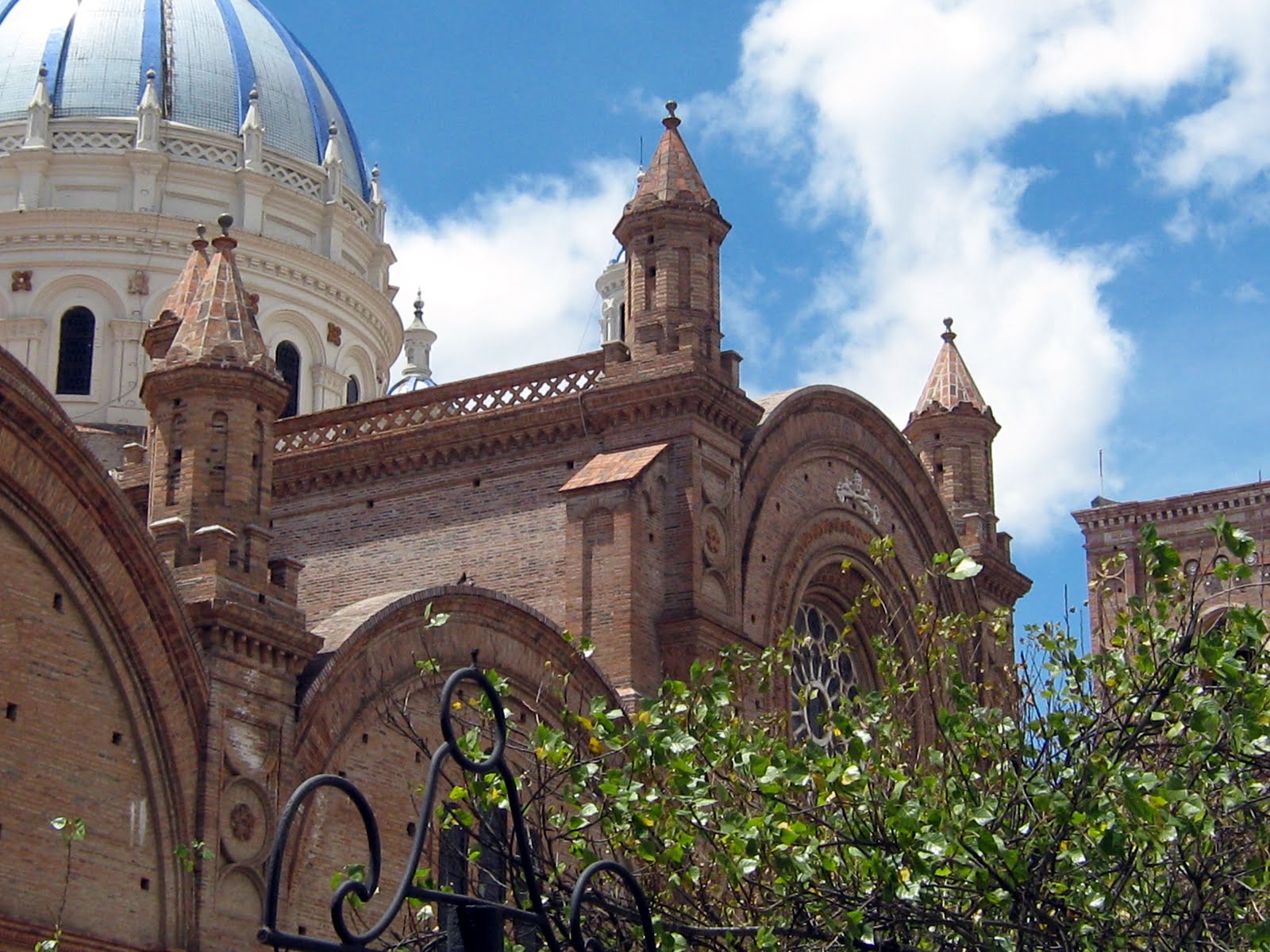
The new Cathedral never failed to impose its sheer size and beauty on us,  its immense bell towers, the bright blue tiled cupolas, the patterns and stonework dwarfing all other buildings. I tried in vain to capture its scope with the one camera shot and found it impossible.

Our initial destination though is the Parque Abdon Calderon, Cuenca’s heart, a shady oasis of fountains and benches  in the middle of the commercial centre and separating the two Cathedrals.


In time my reluctant traveller will become one of the elderly men, all dressed in suits and ties, who meet each day to sit and gossip on the park benches.  What they think of my husband’s bare legs we’ll never know, he spoke no Spanish and they had no English.


I could never resist a quiet moment inside the Cathedral and I’m never alone, Cuencans pop in constantly for a quiet prayer or maybe a rest.  Inside the cavernous church with its many side altars and high vaulted ceiling it is so easy to feel at peace with the world.

Outside the traffic is gathering momentum, sellers of religious artefacts rub shoulders with the icecream vendors and a gentleman encased in silver garb, a mime artist, moves past to a new vantage point.  Two policemen chat on the corner.


Older shoe shine men have choice spots under cover on surrounding streets, the youngsters, some no more than 10 or 11 ply their trade in the open park tolerated by patrolling policemen.  Whether our shoes needed it or not we daily paid more than the asking price for our shoe shine, from the youngsters of course. Naturally we were sought after customers.   


On any given day the park will be the focus point for a gala parade, a display of national dancing, of music, or displays of school art.  Even rap dancing, though on Sundays only. When the day’s entertainment starts with a parade surrounding streets are closed and traffic diverted into other parts of the town.  At the sound of music  I begin to hurry and I’m not alone, a festival of national dance has started, and a crowd is gathering.


How many times in the next few months I will race ahead to the sound of music, fearful I may have missed a special celebration, wondering how everyone else seemed to know the day’s events and I didn’t.  But of course they all read their Spanish language newspapers, while gringo me wanders the streets in ignorance.

_________

Robyn Mortimer


Wednesday, November 3, 2010

CUENCA 3. .. 7AM – THE WORK DAY BEGINS

CUENCA THROUGH AN AUSSIE GRINGO’S EYES

To recap, the reluctant traveller and I have arrived in Cuenca to visit family.  We plan to stay 3 months, but already I have fallen head over heels in lust with Cuenca.  I can’t get enough of it, join me as I kaleidoscope our visit into one single day.

The building our children, Jen and Chris, have purchased is in the process of extensive renovation and at 7 am every morning excepting Sunday the workers, Hector, Patricio, Edwin and others who changed as  weeks turn into months, arrive to start their day.  Without exception they turn up spick and span attired for a social event rather than a back breaking nine hours of hard yakka, hanging their town clothes carefully on nails in various corners of the work site before changing into the more practical bits and pieces they  will  wear while working on a multitude of messy jobs.

At days end a scrub under the tap, back in their good gear and you could never guess only moments before these handsome young men had been immersed in mud and debris.


It is still early morning and street cleaners are out meticulously sweeping their patch, a chore they will repeat again in the afternoon.  Cuenca is a clean city, the most debris you might see is the occasional fruit peal or the even rarer cigarette butt, and these would no doubt have been carelessly tossed away by a thoughtless tourist.   I don’t recall seeing a native Cuencan lighting up a cigarette.
 
At breakneck speed  buses from outlying areas bring workers into town.

 At this early hour district produce markets throughout the city are opening for business, fruit and vegetables arriving fresh from outlying districts; smells of freshly baked rolls and pastry filling the air.


In the same Mercado the meat and poultry vendors are stocking their counters, fish has arrived from Guayaquil on the coast while in the small Almuerzo cafes that dot the city, meals for as little as US$2 are being prepared, some to be eaten for breakfast.


The flower market squeezed into tiny El Carmen Square between Plaza San Francisco and the Cathedral across from Parque Calderon gradually turns into a riot of colour.


Cuenca is stirring and I’m anxious to get out and about.


________

Next

Monday, November 1, 2010

CUENCA PART 2 – BETWEEN MIDNIGHT AND DAWN

CUENCA THROUGH AN AUSSIE GRINGO’S EYES


The plan is to condense three months into one day, I’m aiming for six chapters, that’s four hours a pop, should be a breeze!


Home is in the centre of town, on busy Calle Larga or Long Street, not far from the Tomebamba River... 

The building is traditional adobe and very old.  It has two storeys and two central courtyards, and over a period of months will require a great deal of restoration.  It is a daunting project I would never attempt, but luckily Jen and Chris can see beyond the neglect, the mud and the grime, for them the grand old building and its address, right in the heart of the old city, has great merit.

Formerly a furniture outlet facade hiding an old colonial hacienda, the shop itself  and the original building behind will be repaired and restored  over a frustrating long period to re emerge as a tasteful and elegant addition to Cuenca’s historical centre.

THREE STAGES TO PERFECTION
 Across the road live the coconut sellers, an extended family  including many children who peddle their wares through the streets of Cuenca; coconut juice straight from the shell and slices of pineapple.  


Far from being a noisy intrusion, the arrival of a delivery truck usually just before midnight signals for us an excited rush to the first floor windows.  A frantic unloading of produce has begun,  each coconut tossed to a chain of family members, eventually  ending out of sight inside the darkened building.  The entire transaction is  accompanied by a combined buyer seller reckoning of quantity,  uno, dos, tres, cuatro up to and beyond the hundreds...the tally repeated in turn by vendor and buyer. The tally must match.


Once the accounting and no doubt the paying has been accomplished and all the coconuts stored behind the shuttered doors, peace and quiet  is restored to the street.  The coconuts will emerge again next morning , neatly stacked on the tricycles ready for sale.


With the coconuts out of the way we settle down to sleep.  I snuggle under the blankets, outside its not cold and its not hot.  Like ‘baby bear’ in the three bears nursery rhyme the weather is just right.  But I do smile when I think of friends back home whose first thought was South America, Ecuador, equator, hot as Hades!

Of course they all forgot about the Andes, those incredibly beautiful mountains stretching from the tip of Chile way north to Ecuador and beyond.  The high altitude that guarantees an equable climate and no nasty little bities or creepy crawlies to mar your day.

And so begins and ends our first night in Cuenca.

__________
Next – Part 3.
7am  - THE WORK DAY BEGINS

CUENCA 1 - CUENCA THROUGH AN AUSSIE GRINGO'S EYES

FIRST IMPRESSIONS


Ecuador had stolen my daughter, now Cuenca was grabbing me.  From that first glimpse as our aircraft circled the city I knew I had fallen under its spell.


Below lay a sprawling tightly packed city, houses and buildings spreading out through a shallow valley;  mountains and foothills, narrow rivers tumbling over rocks and under bridges, church spires and huge blue domes, orange tiled roofs. Pure magic! I quickly realised I was falling in love with a city I had yet to step foot in.

The reluctant traveller and I arrived in Cuenca, in Ecuador’s Azuay Province as visiting family, honorary residents for the duration of a stay that would stretch to three months.  With passing time it became easier to understand Cuenca’s attraction, it’s magnetic pull, but how to adequately describe it?

The only way was to encapsulate all our days into one.  Tucked away in the high Andes,  Cuenca is an adventure waiting to happen, a city of endless exploration and discovery; a community where the  everyday theatre of life is colourful and diverse and where the unexpected unfolds in the blink of an eye. 


A casual walk through the narrow one way streets might reveal the joy and thrill of a Mariachi Band, or jugglers tossing colourful balls, stilt walkers, a religious parade, a peaceful protest.  Or the eye may catch just the one particular face in the crowd.


Day after day we roamed this beautiful city on foot, occasionally hopping on a bus, riding it to the end of its journey somewhere high above the city.  But most often our daily meandering led us first to  Parque  Calderon, named after a revered freedom fighter, a green patch in the middle of the city’s business and religious centre where photographers and their fake horses tout for business under the shadow of the great domed Cathedral. 


In comparison to Europe and indeed to any other part of the world there are few tourists roaming the streets of Cuenca.  I have no doubt this will change very quickly as visitors like myself extol its many virtues.  

But for this moment we are enjoying  the novelty of our presence.  Strolling the tree lined pathways of Parque Calderon , just two foreigners in the midst of a Cañar community.

Under the fixed gaze of the flag wielding hero himself shoe shine boys beguile you with huge brown eyes their hands stained with dark polish while vendors offer ice cream cones and meringue confections.

 
Some set up their pitch in the busy  park thoroughfares  to be dispersed after a while by  a patrolling parks policeman in a dark blue uniform.  It’s all very light hearted, within minutes the vendors are back.

This six part chapter and verse will be the sum total of all our days, from the moment the church bells begin to peal early in the morning to the occasional ‘please god’ final explosion of fire cracker bombs, sometimes late at night, a catalogue of everyday Cuenca  through an Australian gringo’s eyes...

And what better time to start than the deathly quiet of midnight...

_________

NEXT     Cuenca Part 2 - Between-Midnight-and-Dawn.


Robyn Mortimer


Friday, October 15, 2010

GUAYAQUIL –MURALS AND IGUANAS

Andes above the clouds

Ecuador had won our hearts.  It had also stolen our children; well one child to be exact.

Daughter Jenny and  husband Chris formerly of Homeleigh in northern New South Wales had found their personal El Dorado converting a run down building in the historic centre on Calle Larga  into a welcoming haven for locals and visitors  to Ecuador’s hidden secret, undoubtedly the jewel in its mountain topped crown, Cuenca.

We had made the long trek from Australia and stayed with them for three delightful months.  Delightful except for the havoc wreaked by our travel agency in Brisbane when they blithely changed our return flights without first informing us.   But all that was now just a horrid nightmare, we were back on track and heading down to Guayaquil to start our return flight home.
The twisting road led straight down

Tearful goodbyes behind us we first piled on extra woollies as our hired car crested the high altitude peaks  only to throw them off as we approached the tropical coast and Guayaquil;  Ecuador’s largest city.

We were back in sprawling suburbia,  high rise and concrete everywhere, humidity and heat.  We were both in shock.  For three joyful months we had been neither cold nor hot, we had walked literally everywhere, been assailed by colour and character, had delighted in conversations  and friendships with the locals.  Cuenca had come very close to stealing our very being.

With limited time to explore and luckily not able to see what lay ahead at its airport we set off to walk Guayaquil’s city centre.  This obviously was no Rome or Athens nor was it a smaller version of San Paulo;  or for that matter, thank goodness,  a soulless variety of any number of major cities back home.

Guayaquil was indeed a city of Spanish inheritance, it had pockets of grandeur and colour and surprise. 

For a start it had iguanas.

Did your thoughts immediately spring to Elizabeth Taylor and the ‘Night of the Iguana’.  No? Obviously you're  far too young for  Hollywood trivia;  but no doubt  you have seen the marvellous documentaries about the Galapagos and the not so little creatures that run amok there.
A squirrel passing the time
 
Well now, as we soon found out together with squirrels and tortoises, iguanas also have free run of a small park right in the centre of Guayaquil’s highrise central business area.  Parque Simon Bolivar is a neat  handkerchief sized  parcel of clipped lawns, massive shade trees, small ponds  and an enormous and growing family of free ranging Green Iguanas that can reach two metres in length.
Lunch time in the park


At this stage I hadn't checked the trees above
The park is bounded by busy traffic laden streets, overlooked by the city’s Cathedral and within a few blocks of the Malecon or waterfront.

The day we were there at least two school groups,  youngsters immaculately dressed  in school uniform, were busy teasing and in turn being teased by the resident iguanas.  Not that the kids were scared, like youngsters everywhere they shrieked with delight when the slow moving prehistoric looking overgrown lizards  lumbered anywhere near them.
Just two friends passing the time

Park workers ensured the Iguanas had plenty to eat with mounds of vegetable greens piled in various locations though I did see at least one being fed the remains of an icecream  by a generous  toddler.  

We also discovered the hard way that iguanas climb trees and spend a lot of time lolling in a heat induced slumber upon tree branches high above.  Some of the shrieks I imagine, were the result of a smelly discharge from those tree trunks.   I know mine was.

The day we were in Guayaquil coincided with a student demonstration and the streets were at various places blocked by police in riot gear.  But I noticed the general population seemed impervious to what was going on and continued through and past the police cordons as though they didn’t exist.

I liked their approach, treat a problem as one would a  storm in a teacup and it quickly becomes one.
A storm in a teacup

But there was another part of Guayaquil’s make up that intrigued me. In Cuenca where I’m told there are 52 churches, one for every Sunday of the year, religion plays a huge part  in the lives of the local people.  Barely a day goes by in that Andes city without a religious parade or demonstration enacted by devout and humble people.  It seems their religion is an everyday affair with direct ties to families both past and present.

Here in Guayaquil, I wouldn’t have the chance to observe their church going ritual,  and I  guess  on such a short visit such deep thoughts really never entered my head.

But then as I rounded a corner in a busy office lined street thronged with people scurrying each and every way, and hesitating to cross against the traffic of buses, cars and honking horns I glanced up  at a building opposite.   What I saw immediately transported me back in time to a childhood  of catholic schools and colourful prayer books.

The building that caught my eye was some four or five stories high, and on two of its visible walls were a collage of  beautifully crafted murals of the Nativity, of Mary and Joseph, and of Jesus.


Yes religion is alive and clearly evident on the streets in everyday down town Guayaquil.

ECUADOR
©Robyn Mortimer 2010

Tuesday, October 5, 2010

A BARBER FROM CUENCA

MUNDANE CHORES WHILE TRAVELING

 The actual day to day business involved with travel often touches on various necessary domestic chores. Beds and sleeping we’ve already covered, transport? Hardly  described as a chore, but hey, hair and  grooming...now there is an interesting subject.

I’ve taken you through my daughter’s experience in Bombay  when a shampoo and dry involved a vacuum cleaner and a quick rush to the lady’s loo to douse her head under the cold water tap; On supermarket shelves I’ve searched shampoo articles in foreign languages invariably agonising on the wrong choice. 
 And I’ve shown you the itinerant barber and his tools in a remote open air market in China, but the most interesting and entertaining  anecdote would have to be the Reluctant Travellers experience in Ecuador.
The Reluctant Traveller is a no fuss person, back home his greying hair is butchered by a retired barber friend who does the work,  short back sides and top, in our front sun room along with other local cronies who front up for the gossip and the convenience.

The barber also a neighbour and old friend is particularly fond of a scotch or two so its always wise to grab him long before the sun has risen over the yardarm.

So faced with a three month stay in South America it goes without saying  my Reluctant Traveller will at some time be in need of shearing. The inevitable day arrived, son in law Chris offered to tag along to interpret and get himself a shave at the same time.  I tagged along to photograph proceedings.

My daughter had spied a barber shop up past the local  vegetable market that appealed to her sense of antiquity.  Original furniture, implements, advertising and obviously original owners as well.  

This would be fun I remember thinking, an eighty year old customer being attended to by an 80 plus barber.  At least I couldn’t see any scotch bottles lying around.
A close shave

While I read the local papers

 
Son in law Chris scored the younger of the two men in attendance, while the older, almost a clone of my golden oldie, installed my husband in a grand old chair first used, as he pointed to a picture on the wall, in Chicago at some time before the war.

I assumed he meant World War 2.

My mind immediately tuned into Chicago’s St Valentines Day Massacre and I took another glance at the kindly old man wielding his scissors and tucking a towel around my husbands neck. Surely he couldn’t have been around in the days of  Al Capone...early 1920’s?  No, not even the Reluctant Traveller is that old!

The job in hand proceeded with bilingual conversation involving Spanish chatter from the barber and Aussie monosyllables from guess who.  Chris was trying to interpret but his barber was flying, or should that be shaving, rather too close to the wind and my son in law was wishing himself anywhere but in that chair.

I picked up a Spanish language newspaper and couldn't make head nor tail or it, following instead the pictures.

At last the job was done.  Stan’s haircut I thought was better than our friend's effort back home; Chris’s face though was beginning to look rather raw. We paid our money, an unbelievably cheap couple of dollars, and with much Gracia's and smiles departed.

The fun part came some weeks later when the Reluctant Traveller and I passed down the same Cuenca street and glancing into the barber shop saw the older man hard at work with a customer, and  his off-sider, younger by no more than ten or fifteen years, snoozing away fast asleep in the old Chicago barbers chair.

Snoozing on the job


©Robyn Mortimer 2010

Sunday, October 3, 2010

DARK DEEDS ABOARD A RUSSIAN SHIP

    Having at times made the statement that money isn’t everything, any committed traveller, however really needs to think carefully about one absolute necessity; cash.  No matter how thrifty you are there is still a need for a healthy lot of folding money.

     Following an early solo venture when I foolishly set out with my first ever credit card, I vowed there and then to cut the plastic night-mare into tiny pieces; the amount owing was beyond belief.
Aghast at a huge bill I needed to conceal from the husband I sometimes call the Reluctant Traveller, I was forced to sacrifice my entire collection of early edition National Geographic magazines, a chunky gold bracelet and an antique Royal Doulton ceramic, a rare birthday gift from him the year before.  Luckily it took many house moves and even more years before he finally noticed the Royal Doulton was missing. 

     I realised it was time to find a paying job, something that might help me continue the fancy free and foot loose persona I had suddenly acquired and desperately wanted to continue.

    A job behind the scenes on a television show opened new doors; a summer perk entertaining passengers on a Russian cruise ship, the Feodor Shalyapin, meant the whole family minus the Doberman could tag along to Singapore as well.

   The Russian vessel had been purchased from the Cunard Line mere months prior to sailing for Australia.  Known in its previous life as the posh Franconia, the ship had been lying at anchor in a UK river for a considerable number of years and wasn't in the most pristine condition.  In fact we would later see proof of this when crew attempted to lower the life boats to transport passengers from ship to jetty at Bali and one motorised boat crashed through the deck rails instead.

Two surviving life boats in Bali


    This was also the Russian crews first time out of the Soviet Union and while the captain appeared to be senior officer in charge that title and responsibility actually belonged to a  female KGB officer who outranked him and operated from an office somewhere below deck.

    The liner sailed into the tropics and before long I noticed the ships large and jolly seamstresses working non stop on what appeared to be new poolside uniforms for staff.  The sewing machines were set up in the ships laundry and every time I went down there I was amazed at the number of laughing jostling crew, both women and men, striding around modelling newly made distinctively patterned bikinis and swim trunks; somehow the fabric seemed vaguely familiar.
  
    A few nights later while trawling the decks for my thirteen-year-old son who apparently had won the motherly affection of the American entertainer, vaudeville violinist, Edith Dahl, ‘a busty blond well past her use by date and old enough to recall prohibition’, I came across a puzzling sight.  Stretched out in the ships wake, bobbing up and down and clearly visible in the moonlight, was a long line of wooden deck chairs. 

    Immediately the penny dropped.  The crew were stripping off the woven fabric covers and throwing the denuded skeletal evidence overboard.    The covers made snappy, though brief swimmers. The Feodor Shalyapin was a wacky ship with an even wackier crew. But that wasn’t the only weird thing that happened. 

That's my errant son flying through the air as we crossed the Equator.
 
     It was suggested passengers not converse with ship’s officers because they spoke no English, but when the Reluctant Traveller and I joined the captain in his cabin for a memorable Russian feast complete with endless vodka toasts both he and his charming first officer spoke perfect English. 

    Then late one night while searching the decks for the errant son who had again overstepped his curfew, this time playing cards with the crew, I saw the dark shadow of a submarine emerge from the depths; very quietly shadowy figures were transferred back and forth from the sub before it moved off out of sight.  

   Next morning I ran into the second officer and bubbling with curiosity asked him about the submarine.  He looked at me for a second or two and then said, ‘what submarine?’  It was the last time I heard him speak English.  It was the end too of our cosy little dinners with the captain.

___________
©Robyn Mortimer 2010

Wednesday, September 29, 2010

SHOES, SLUMBER AND SUICIDE IN NEW ZEALAND


I am ashamed to admit that over the years I had continually avoided New Zealand, instead visiting exotic countries like Turkey or Uzbekistan, Jordan or Macau.  New Zealand is our closest neighbour, our next door neighbour to be exact.  Apart from a few language oddities I always thought of it as an extension of us, of Australia;  a country so conveniently close  I could always take a gander some time in the future...but not right now.  There were other agendas I considered far more enticing.

How wrong I was. 

The reluctant traveller, my husband,  had agreed to take another trip and we soon found ourselves in New Zealand’s South Island where we instantly fell in love with its people, its breath taking beauty and even, though I suspect we were lucky that particular year, with the climate.


Neither rain, hail, shine nor snow will stop him wearing those shorts.


We soon realised New Zealand was to some extent a clone of our homeland, a time warp as we had been some years before; a country that moved slowly, comfortable in itself, yet to taste the influence of foreign television and the excesses of American culture, a country of Kiwi entrepreneurs with a sense of humour.

We hired a car, bought an esky, frying pan, cutlery and a few plates at a second hand store and set off from Christchurch with the vague idea we would just saunter around as the will took us finding accommodation wherever we chose to rest our heads, picnicking along the way.

With a map in hand but no intention of slavishly following it we chose roads at random our progress slowed by a constant need to stop and gape at a landscape so beautiful and startling we could only stare in amazement.  Snow capped mountains, vistas of rolling hills and rushing streams and small towns with not a fast food shop in sight.

We bought fresh smoked salmon from roadside stalls, Chardonnay to die for from vineyards dotted along the way.  Crusty bread fresh baked in local bakeries; even the milk tasted different to home, somehow more like real milk should taste.

At one point we stopped in a desolate area on a simple country road to puzzle over a barbed wire fence.  An ordinary fence used here for an unusual if not extraordinary purpose.

Unheralded and anonymous the Shoe Fence was the only way I could describe it. Strung along a good 200 yards or so were shoes and boots of all description and size; elegant ladies court shoes,  leather boots, aging sand shoes, adults and children’s, all in pairs and some very desirable. 


I eyed off a pair of imported shoes I would gladly have exchanged for the pair I was wearing but they really weren’t suitable for rugged touring.  Besides it didn’t seem right to interfere with this ingenious display.

My only regret as we drove away was our inability to add to this anonymous collection.

A few days later we had cause to remember the vagaries of sleep deprivation and instant slumber we had witnessed  in Japan some years earlier.

During our New Zealand meandering we chanced upon a small airfield offering light aircraft flights over Mt Cook and the snow fields.  A plane was due to leave within minutes with one solitary passenger. There was room enough for us, so we clambered aboard.

The other gentleman was an elderly Japanese tourist, his daughter had declined to accompany him but he was obviously looking forward to the experience and we all shook hands and exchanged smiles with the pilot.


The oriental gentleman had taken his seat behind the pilot, my husband won the toss to sit up front at the controls, and I was snug against the window behind Stan.  The engine roared to life, the props turned and we were off.
 
But we hadn’t even taxied down the runway before I realised the Japanese gentleman beside me was fast asleep.

The flight over snow bound Mt Cook was incredible,  one we would never forget, but all the time the foreign passenger continued to sleep.  I considered shaking him gently awake but he really looked so peaceful I found I simply couldn’t disturb him.

All too soon the flight was over and we made a perfect landing taxiing to a stop by the ticket office.  As the engines gradually shut down I glanced across to see the old fellow blinking, his eyes now open, his expression inscrutable.

We alighted and the old man’s daughter rushed up, excited and voluble, chatting to him no doubt about the flight, how he enjoyed it.  They wandered off to their car leaving me shaking my head in disbelief.

The cost had not been all that much, certainly well worth it from our point of view.  But simply to accommodate a comfy seat and an afternoon nap? I don’t think so.

__________


DEFYING DEATH


My husband can be deviously surprising.  One of New Zealand’s claims to fame is the invention of the Bungy Jump.  A suicidal leap from a high platform separated from certain death by a long rope attached to ones ankles.

Detouring through Arrowtown, we came across a local bridge, a huge crowd, a rushing river beneath and a queue of what I termed were idiots waiting to launch themselves voluntarily into oblivion.  We spent perhaps three quarters of an hour watching this steady stream of jumpers with me looking on in horror and finally relieved when we drove off to find that night’s accommodation.

Usually Stan holds off the search until it is almost dark, he is always loath to waste a moment of driving time.  Entreaties by me as we pass delightful little establishments in broad daylight are met by a look at his watch and the comment “Too early to turn in yet”. So I should have smelt a rat when he drove back to Arrowtown pulled in to the first motel we saw and promptly broke open one of our gorgeous bottles of New Zealand wine.

Next morning we headed off on what I thought would be the direction of Milford Sound when I realised he was pulling into the Bungy Jump office.

Honestly, is there any need to explain further.  He filled in his particulars, signed the responsibility clause, paid over his money and joined a small queue of much younger volunteers all waiting to defy gravity and death.
 
We are talking here of a man then well in his seventies, supposedly of sane mind. 

His turn came, he made a joke about being the oldest bungy jumper, then with a wave to me and the adoring crowd, he took a deep breath and with a perfect swallow dive leapt into the air.

The jump was successful and more to the point I survived the whole nerve wracking affair;  but Stan’s boast about being the oldest jumper was dashed, a 90 year old had well and truly gazumped him the year before.  One consolation though, he could now jump at any bungy post in New Zealand for half price...

Again, I don’t think so.
_________


The bridge...
THE BRIDGE


THE WAVE GOODBYE


THE LEAP


_________________


Robyn Mortimer ©2011