Wednesday, March 16, 2011

ANCESTORS 18 –FIJI NOEL COWARD-AMELIA EARHART & FRANK FLEMING

THE CANTON IS. CONNECTION

Synopsis:  In Ancestors 17 you met Frank Fleming, an orphan from London who went on to fly planes in World War 1, and then eventually made his way to relations living in Fiji.  This story continues his life in the years leading up to WW2.


In 1937 the American aviatrix Amelia Earhart and navigator Fred Noonan disappeared on the third leg of a round the world flight.

Last radio messages were received off the Gilbert Islands where her aircraft was scheduled to make a refuelling stop some hours after taking off from Lae, New Guinea.   No trace has ever been found of her plane nor of Earhart herself or her navigator,  though to this day the search for their remains still continues.


THE STORY SO FAR*

My American Grandfather has died in Sydney just two years before the end of WW2.  His wife Maggie, my grandmother makes her first trip home to Fiji in over forty years spending quality time with her brothers and their families before returning to her family in Australia.

In the years following her death, I give little thought to Maggie’s past until a cousin finds a number of old newspaper clippings and letters that clearly show our American Grandfather has been living a lie.

In starting the search for his real identity I uncover startling facts about Grandmother’s English forebears.  This leads me back to Fiji, to that last visit Maggie made in 1946 and to a cousin she met for the very first time...

oOo

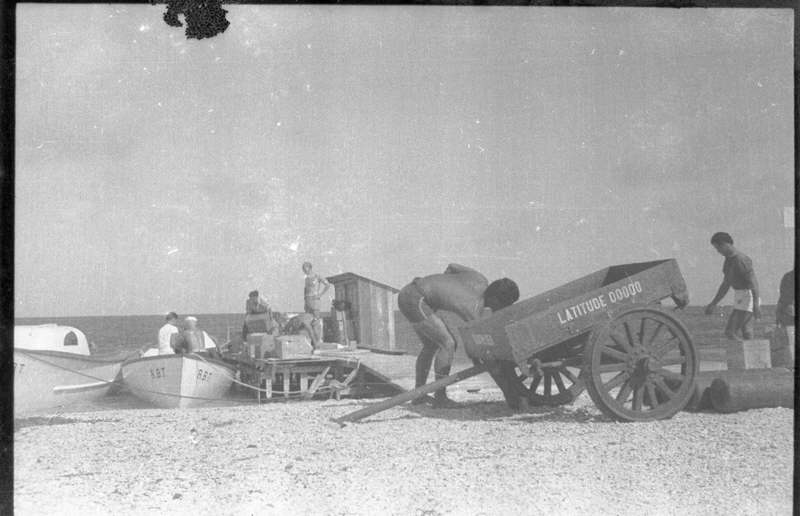
FRANK FLEMING ON CANTON ISLAND

Canton Island is just one of numerous small atolls in the Gilbert Ellice Islands region of the Pacific now known as Kiribati.  Part of the Phoenix group close to the equator, the islands low rainfall had always prevented colonisation. 

For a time the only visitors to the small sand cay were whaling  and guano ships. In the 1850’s Britain made an initial claim to the island group, reasserting sovereignty in 1936 when the islands came under the jurisdiction of His Excellency the High Commissioner for the Western Pacific at Suva, Fiji.

 Then in 1937 the island was visited  briefly by New Zealand and American scientists witnessing a total solar eclipse under the auspices of the National Geographic Society.

At this time the American party claimed the island for the United States erecting a small monument with two American flags.


Frank Fleming, man in white immediately below the word ‘Canton’.  Woman to the left of photo wearing a hat could well be Lucy Fleming.

For a while relations between the USA and Britain were a bit strained and there is a popular story that the British warship HMS Wellington fired a shot across the bow of the USS Avocet when the Americans refused to cede anchorage to the British vessel. 

The Island became a bone of contention with both countries operating manned bases on the tiny sand cay almost side by side: The British with their three radio men each day raising and lowering the Union Jack  and the seven man American group doing the same with their Star Spangled Banner. 

The stand off wasn’t resolved until 1939 when London and Washington signed a joint administration agreement to control the Canton and Enderbury Islands condominium for the next forty years.

America however, recognizing the strategic value of Canton Island’s sheltered lagoon quickly established a Pan Am Airlines base for their flying boat Honolulu to Auckland clipper service. This included luxury hotel accommodation for passengers should an aircraft be forced to stay overnight.

While all this was going on Grandmother’s cousin Frank Fleming manned the British radio communication shack virtually next door to the Americans.  As Noel Coward so aptly put it, the Flemings  in their ‘packing case’ home were entitled to display ‘a certain irritation at the Americans who have so much luxury.’

Lucy lived with Frank on the island for some time until war news from Europe indicated the conflict might reach to the Pacific.  She returned to Fiji. 

Frank remained until 1942 when sick and exhausted he was evacuated to Suva where he finished the war as an official wartime censor.  Noel Coward kept in touch, arranging, as he had promised, a Royal photograph to be forwarded from the Queen.  Coward even wrote a story loosely based on the Flemings that he called Mr and Mrs Edgehill, later made into a film starring the British actress Judy Dench.

oOo

THE EARHART MYSTERY

Frank would have been aware at the time, of the mystery surrounding Amelia Earhart and Fred Noonan’s disappearance. He had not only been involved with initial planning of the Canton Island base, he had also spent some time in an official capacity as assistant Commissioner on other islands in the Gilbert group. 

Following the bombing of American bases in Hawaii, the American High Command took over Canton Island,  Pan Am services ceased and the Pacific very quickly became a major theatre of war.

But while WW2 overshadowed the mystery of Amelia Earhart’s aircraft, the circumstances surrounding the crash never disappeared from public view. Countless sightings of either the aircraft or pieces of wreckage have been reported, and discounted. As recently even as March 2011 newspapers carried reports of the sighting of a submerged aircraft suspected to be Earhart’s Lockheed in waters off New Guinea. 

In 2003 however the report of a sextant box in Fiji set in motion yet another investigation...so far as this story is concerned a very important investigation.

oOo

FIJI - 2003


The box in Dr Murphy’s kitchen

The search for Earhart’s plane and the controversy over her death continued for many years until 2003 when the International Group for Historic Aircraft Recovery, TIGHAR sent two men to Fiji. 

They were on a quest to investigate the recent finding of a sextant box thought to belong to Amelia Earhart and her co-pilot, Fred Noonan. 

Martin Molenski, a Jesuit priest from Buffalo and Roger Kelley ex Marine sergeant formerly with the Los Angeles County Sheriff’s office located the box in question in the home of Dr. Gerald Dennis Murphy. The box had come into the doctor’s possession when a patient and friend, Frank Fleming, lay dying in a Suva hospital. Doctor Murphy himself was now ill, his mind was failing and he was virtually on his deathbed.  

A Catholic priest and close friend, Father Michael Bransfield arranged for the TIGHAR team to search personal effects in the doctor’s home.

They found the reported box but it was obviously not the box they were searching for.  Then Father Bransfield reminded the housekeeper about another box that the doctor and his wife would often bring out at dinner parties to show their guests. 

 The housekeeper fetched a small copper container, green with age.  As Martin Molenski said, it was a treasure chest, just not the one they had travelled half way round the world to find.

And yet its contents were so intriguing, instead of walking away the two men from TIGHAR delved further.

oOo

A TREASURE – BUT THE WRONG TREASURE

As Molenski and Kelly soon discovered the box held the mementoes of Francis Ivor Fleming, a friend and patient of Dr. Murphy who had given the box to him in 1968 just before he died of tuberculosis in a Suva sanatorium. 

 Inside the box was Frank’s birth certificate, his appointment as a World War 1 Lieutenant in the Royal Flying Corps, first day issue stamps, signatures from early aviators, letters from his sister in England, flags he had flown over Canton Island, newspaper clippings, five handwritten poems by Noel Coward, Frank’s deathbed diary and five rolls of damaged photographs and film.

Dr. Murphy died not long after the TIGHAR visit and the box and its contents passed into the care of his daughter Denise Murphy.  The spools of film, by now sixty or more years old, were in a sad condition. Roger Kelley hoped they could be salvaged and restored by the American College of Forensic Examiners. 

Denise relinquished any hold on the sixty nine year old spools of  film to the Americans and thus began the long and arduous process of converting approximately 200 negatives to digital format.  The task was completed in 2007, and the negatives were promptly placed on Photek’s website for viewing and discussion.

oOo

GOOGLING FRANK FLEMING


In the meantime while the lengthy TIGHAR and Photek investigation was being completed, I was coming to grips with all the new Sweeny history the two Fleming cousins were supplying me with.

It took a while for Frank Fleming’s incredible story to surface.

Even though there were letters from Frank’s sister in England among the contents of the box these were not part of the American search.  Nor for that matter had they been closely perused by Dr Murphy and his daughter in the 35 years following Frank’s death.

It really took a magazine story written by Father Martin Molenski, entitled  ‘Amelia Roger and Me’ to alert the Flemings and me to this latest development in the life of Frank Fleming.

For my new Fleming cousins the emergence of Frank’s life story was incredibly precious, but at this stage I was still unaware of the impact it would have on me.

The Americans had taken possession of the five rolls of film from Frank’s box, after all they were in a bad condition and in dire need of expert assessment, but the rest of the boxes content remained with Dr Murphy’s daughter Denise, who by then was living and working in Hong Kong.  Mention had been made of a death bed diary among the boxes contents and naturally the Fleming ‘cousins’ were keen to read it. 

I forged a link between the two, the Flemings in England and Denise Murphy in Hong Kong and the diary was then express mailed to them.  In the diary Frank reveals his last days, the slow realisation he won’t be returning to England as he had planned, the fact that he had burned all his previous diaries, and the visit to him on his deathbed by Noel Coward.

I’m sure Frank himself would have been moved by this end result, it had taken a long, long time but at last he was home with family.

But the story doesn’t end here.

oOo


FRANK’S LEGACY

The American College of Forensic Examiners had their work cut out attempting to restore and convert to digital image some 200 negatives from Frank’s rolls of film; some were colour 35mm, some half frame, some from a Leica camera.  All were affected by age and tropical heat.

The end result was scanned by Jeff Glickman and Photek with the images generously  made available for public viewing on Photek’s secondary website.

It was mid 2007 by the time I came across this website collection of photos after being alerted by the Flemings in England.  They had looked through the footage but apart from what were obviously shots taken of Canton Island, without at that stage the diary they were really none the wiser.

I’m a night owl, happiest researching and typing in the early hours before dawn. I was curious to see photographs taken all those years ago by Geraldine’s nephew.  I imagined they would be photos of he and Lucy, and probably of their years on Canton Island.

So I approached the five film sets with nothing more than curiosity.  Roll A was, as I thought, still camera shots of everyday life on Canton Island circa 1940, fascinating nevertheless. 


The next spool showed what was obviously a victory march through Suva that could be dated to 1945.  Then an extremely damaged shot of Lucy shown strolling with friends on an island.  This would have predated the 1945 film and could have been taken as early as 1937.


The last spool, a more recent one probably taken just before Lucy’s death about 1967 shows Lucy strolling on the beach of Nukulau and in the garden of their home.


We are granted a reluctant shot of Frank.  Has Lucy taken the snap, has she teased and begged him to look up at the camera.


The next and last photo of Lucy is taken on a launch taking her the fifteen kilometres from Nukulau to Suva, or perhaps making the reverse trip home.
 
Lucy has aged, no longer the eager young woman revelling in her first taste of the islands;  but we must remember by now she would be in her late seventies.

She has potted some of her precious plants, a gift for a friend,  for Lorna McGowan perhaps, Andrew McGowan’s daughter, or maybe even Frank’s cousin Lulu Marlow, Geraldine’s Foreman daughter.

Her dress is the same simple style that suits her so well,  her face is framed by a shady hat, she wears small stud earrings and just a faint dash of lipstick, a pale pink.


There is a great sadness in Lucy's eyes.  Does she already know she is ill, that her time with Frank is drawing to a close; is the weight of that knowledge almost too hard to bear?

Is Frank trying to capture on film every last moment they’re together?

oOo


MAGGIE’S SMILE

By some strange quirk I had chosen to view the second roll last.

Nothing could have prepared me for the images I was about to see. 

The movie film was described as extremely brittle, with 50% of the negatives fused and impossible to separate.  The quality of the salvaged stills was bad, the subject matter in most cases faded and indistinct.  But there was enough detail and clarity for me to recognize two of the three women pictured greeting each other, laughing and smiling as they strolled through a tropical garden.

For an astonishing moment time stood still: I didn’t dare believe the images on the screen.

I sat there, alone at my computer, bringing up each sequence.  It was the fourth image that set me tingling, brought a quick rush of tears.  I was immediately carried back more than sixty years to my childhood.  

The woman I was looking at on that resurrected film clip was the other half of my very being; exactly as I remembered her, my much loved grandmother Madge Maud Brown Parker.

Maggie, small and elegant in her best town suit, plump in a cuddly way;  I smiled, suddenly recalling the old style corsets she wore to discipline the added pounds.  The stylish shoes, handbag to match:  Her hair so like mine, fine and wispy, neatly piled to frame her face.  The laughing eyes, the gentle smile.  I felt tears begin to well.

I don’t know how long I sat there at the computer, quietly revelling in this amazing find. I found it unbelievable.  Here I was sitting at a computer, sixty-five years later and many, many miles distant, watching Maggie, in Fiji, strolling through a garden with her brother Gordon McGowan’s wife, Minnie Rosa. The slim younger woman with them had to be the photographer’s wife, Lucy.


I sat alone in the quiet darkness, the computer screen glowing bright and stark.  I had no one already awake to share the moment with.  It was then the tears began to fall.  I felt my darling Grandmother was there with me as she had been all those years before, so close I could almost reach out and touch her. 

Of course deep inside I always felt Maggie was there, she had never really left me, but now with this superb gift we could visit whenever we liked.   I had only to click onto a web site.

oOo

I’ve given a lot of thought to this journey through time, and the totally unexpected point I have reached.  All these new found families, relations, their secrets, the very human nature of the mistakes some of them made.

And I thought of Frank Fleming, the orphan, and his life’s journey; from the slums of London’s dockside to a Pacific paradise on the other side of the world.  His loyalty to King and country.  But mostly my thoughts kept returning to the woman he loved, Lucy Penfold.

There have been times I’ve wondered if this long, long journey into the past had been pre-planned by some divine or unknown controlling force; a very involved plan with the express purpose of uncovering this unexpected legacy.

Perhaps, perhaps not: but for me it has certainly placed some truth in the saying that ‘if there is a God he certainly moves in mysterious ways...’

I owe Frank Fleming my heartfelt thanks.  In filming Lucy and his cousins, Minnie McGowan and Maggie, he was creating an incredible gift, one that wouldn’t reach its unsuspecting recipient for sixty odd years; the gift of course was Maggie’s smile.

Maggie and me
  
oOo

And not least I must sincerely thank and acknowledge the work and care taken by  the American College of Forensic Examiners, Jeff Glickman and Photek,  Father Martin Molenski and Roger Kelly from TIGHAR, Dr Murphy and Denise Murphy, and the generosity of the modern day Flemings father and son, who each in their individual way maintained a vigil over Frank Flemings life and times.  Without them I would never have enjoyed this last glimpse of my Grandmother.

oOo


 Robyn Mortimer ©2011

1945 Peace and a return to Fiji
*  Fiji – From Orphan to WW1 Pilot


Next – Cloudland..a curious Chain of Coincidence.


Sunday, March 13, 2011

JAPAN

 IN SYMPATHY WITH JAPAN

My memories of Japan are full of happy, helpful people steering my husband and myself in the right direction, of smiles and generosity, of neat and tidy landscapes, of beauty in scenery and design.  Of friends like Tom Oyama and the children at the Tokyo expo who absorbed us into their chattering fun filled circle.

I can't bear to dwell on the images now reaching the world by way of television and newspapers.  It is a horror of unimaginable depth.   

Our disasters in the southern hemisphere, Queensland's floods and cyclones, the earthquake in Christchurch, shocking and heart breaking as they are pale almost, almost into insignificance beside the nightmare the Japanese people are now experiencing.

I can only add my tears to those from the rest of the world.
________

Wednesday, March 9, 2011

ANCESTORS 17 –FIJI FROM ORPHAN TO WW1 PILOT

GRANDMOTHER’S COUSIN

Chance, serendipity, coincidence... there’s no denying luck does play a big part when you set out to explore your ancestors background.  

I started with virtually nothing, a few tattered letters and clippings, my grandmother’s maiden name, my grandfather’s alias, two small towns on a world map, Levuka in Fiji and Peru, Indiana and very little else. Then childhood memories kicked in, followed by search engines and the power and scope of the internet.

But it was surely ‘lady luck’ that placed me on an astonishing collision course for perhaps the most unlikely surprise of my life.

oOo

MEET THE SWEENY KIDS – ALL 16 OF THEM

ESPECIALLY THE LAST ONE...CONSTANCE OLIVIA


 oOo

AN INFLUX OF COUSINS

This is Frank Fleming’s story.  He is just one of many first cousins my Grandmother Maggie possibly never realised she had.  So far as I know she met this man for the first time on that trip home to Fiji at the end of WW2 when she was sixty nine and Frank was eleven years younger. 

My interest in this distant cousin was kindled in 2004 when I made a chance sighting of an error in an 1860 passenger list on New Zealand’s NZ Bound internet site. This led to an invitation to write a short account of the Sweeny family to accompany the correction.

I did and included a plea to anyone who might know how Geraldine Sweeny found her way to Fiji.  That little afterthought enabled five new modern day ‘cousins’ to find me. Two of them, in England, carried the name Fleming and both at the time had  only a vague idea a distant uncle once lived in Fiji.  

These Flemings were a father and son and one had written a remarkable and detailed book about the Sweeny’s but knew nothing about an Australian connection.  In turn I had amassed an amazing amount of information about those four Sweeny sisters from Sussex but really had no idea what prompted their exodus from England.

This joining of minds and clues would prove mutually beneficial.

oOo

THE VOYAGE OF THE PHOENIX

Corrected passenger list NZ newspaper


How Grandmother met Grandfather was and still is the biggest mystery of this entire saga.  At the start of the search, maybe six or seven years ago I decided the only way to unravel this puzzle was to work back from Fiji, back through Grandmother Maggie’s own mother’s family. Maybe that way I could find out how Fiji entered the picture in the first place. 

Before long I started delving into Geraldine Sweeny’s fifteen brothers and sisters and their home town of Worthing in Sussex. At first I thought the parents of all these babies must be very kind people indeed, obviously a great number of the youngsters  just had to be foundlings, babies adopted out of the goodness of their heart.

Slowly I realised Anna Sweeny wasn’t an unusual mother for those times;  like Queen Victoria, none practiced any successful form of birth control and indeed, by some standards a family of 16 children wasn’t all that large.

The four story building to the left of the Steyne Hotel in the centre of this early photograph c1890-1900 is the old Steyne Library, where the Sweeny’s lived until their father’s downfall in 1859.  Madeline would have been the last child born into this comfort. Constance Olivia would know only poverty.

 The house was seized in 1860 and the family forced into penury.  Their lives would never be the same.


Then I uncovered shipping records for 1859 showing the family had taken ship to New Zealand, only eleven in total at this stage, yet a month after landing had returned to Liverpool on another sailing ship, the 986 tonne vessel, The Phoenix. A huge upheaval for such a short stay.

And this is where the luck element stepped in.  The passenger list for the Phoenix attached to the NZ Bound site had included all the Sweeny children’s Christian names but omitted to give their surname.

I skimmed through the list, failed to see Sweeny, did a double take and realised no one could possibly duplicate names that included, Alfred, Alice, Adeline, Geraldine, Bertha, Madeline, Ethelbert, Ernest and Evelyn. They just had to belong to the Sweeny family of Sussex.

Caught up in the improbability of it all I imagined all sorts of scenarios for this extremely long and hazardous sequence of sea voyages; a business trip, visiting relations, a quirky pleasure cruise.    Not for a moment did I think the family was running away, unsuccessfully as it turned out, from shame and poverty.

I’ve touched on the Sweeny story in the first of the Ancestor series, Four Sisters from Sussex and again in Suddenly in Fiji.  In those chapters though I barely mention Constance Olivia, the youngest of the Sweeny’s, Frank's mother. Maybe that’s because she didn’t appear in the Sweeny family until 1863, a good couple of years after the Phoenix episode.

oOo

ORPHANS IN LONDON

A street in Deptford, London late 1890’s.

Constance was the last born of the Sweeny brood, she arrived after the exodus from Sussex and her father’s time in jail, after the birth and death of young brother Reginald. She met and married her locomotive driver husband in Swansea, Wales and they later moved to Greenwich the ship building area of London.

Constance’s mother Anna Sweeny had by now rather generously reconciled yet again with the errant father of her brood and they, and the growing Fleming family, shared accommodation in London. 

The Sweeny’s were elderly and not in good health with Grandfather Sweeny eventually consigned to a charitable Poor House.  Both young Fleming parents then died within a year of each other leaving their eight children, one a babe in arms in their now senile Grandmother Sweeny’s care.

The eldest, Bernard was able to care for himself finding work with an electrician, the baby was absorbed into a neighbouring family and the rest of the children were dispersed to orphanages.

Like me the present day Flemings who were descended from Constance Olivia’s third son Ernest Wilfred, had attempted to trace their family background, in the process uncovering a great deal about the ins and outs of the Sussex Sweeny’s.  But they came to a standstill with young Francis Ivor  Fleming who may, or may not  have found his way to the south Pacific and worked on a Fijian plantation.  

oOo

FRANK FLEMING – A MAN OF MYSTERY

As with all family histories there are huge gaps, and Frank’s story is no exception. Actually, if it hadn’t been for his tenuous connection to Fiji I probably wouldn’t have explored his life and times as thoroughly as I did and I wouldn’t have found this gem of a story that touches on my own Grandmother.

The modern day Flemings father and son are now working on a comprehensive history of Frank’s life.

Through old letters and family hunches, it was thought Frank had somehow found his way to Fiji, probably when he was sixteen. 

Other tantalizing snippets came to light; he had attended a New Zealand high school, was working at the Union Gas Engine Company in San Francisco; all very vague and proving difficult to confirm.

At some time before 1915 Frank was living and working on an island in the Fiji group.  His cousin Gordon Goodenough McGowan, my Grandmother’s brother, married the daughter of another early settler in 1905.  Her name was Minnie Rosa and her father owned and worked a plantation on Laucala Island. This may have been the plantation where the Fleming family believed Frank once worked.  You've seen Gordon and Minnie in the previous chapter, photo taken on Suva wharf.

In 1915 a Fiji lawyer writes a letter of reference in Frank’s favour. War had been declared the previous year; there was a feverish rush to manufacture weapons, build tanks and design aeroplanes for warfare, and to recruit servicemen.  By 1916, Frank is back in England and, from Daimler Station in Coventry writes a letter of application to the newly formed Royal Flying Corps. Within a month he has joined the Special Reserve of Officers as a second lieutenant.  In August he is appointed an Examiner with the Royal Flying Corps and by the following November he is a Flying Officer on active service.

In November 1916 Frank is sent to France as a Flying Officer with number 34 Squadron.  Within three months his RE8 aircraft crashes at Villers-Bretonneux in France fracturing his left ankle and injuring his right shoulder. After a spell in a Brighton Hospital for Officers he is posted to the Wireless School at Hursley Park.

RE8 AIRCRAFT CRASH FRANCE WW1

Two of his brothers, Ernest Wilfred and Bernard George are already fighting with army battalions in France and it is inconceivable to think Frank knew nothing of their whereabouts.

In February of 1918, Frank is attending the Officers Invaliding Board at Arkwright Road Hampstead, and living at 19 Powis Square, Brighton while working at the School of Military Aeronautics in Reading.  He lists his next of kin at the Brighton address as L.E. Fleming, sister. Bernard’s wife, Lucy Fleming’s middle name is Ellen.

In 1918 his brother Bernard instigates divorce proceedings against his wife of fourteen years, the former Lucy Penfold, naming his brother Francis as co-respondent.  Bernard however doesn’t proceed with the action.  The couple no longer live together, but legally Bernard and Lucy are still man and wife.

It appears Frank remained in England until 1921 when he and Lucy boarded the P&O vessel, ‘Borda’, departing London bound for Sydney.  They are listed as Mr and Mrs Fleming: which of course they were, just not married to each other.

oOo

They may have shipped with them on the Borda an aircraft in kit form, possibly a former WW1 plane because in the Fiji Times, June 3rd 1922 there is a paragraph with the heading...

FLIER BLUFFED PRESSMAN


...The pressmen who were interested in Mr Fleming and his aeroplane can hardly congratulate themselves on the treatment meted out to them by Mr Fleming.

Hearing that he was to make an attempt to fly the aeroplane which he has just completed, a representative of this paper motored out yesterday at 4.30 pm to the hangar, which has just been erected on Laucala Beach, a few yards past the racecourse...


The article then went on to castigate Frank for not allowing the press to stay and watch the maiden flight of his aircraft.  An angry Frank was quoted as saying, ‘It’s not a bob a head show for you lot to watch me break my neck!’

The reporter was sent away without his story and a little later Frank climbed into the cockpit, signalled to his helpers to turn the propeller, the engine caught, the plane moved off along the beach gathering speed, and then, before it had a chance to rise above the ground, the wheels sunk into the wet sand, and  the plane crashed.

The first ever flight by a pilot in Fiji had failed.

The aircraft was wrecked. Frank would no doubt have been both embarrassed and considerably out of pocket.  But what the gentlemen of the press had not reported was Frank Fleming’s impressive war record nor his connection to one of Fiji’s earliest European pioneering families.

But this may not have been entirely the Newspaper’s fault.  Frank was a private man and he and Lucy had reason to keep themselves very much to themselves. Divorce at that time  was not a subject for general discussion. But it was probably this essential trait of personal secrecy that made him the perfect choice for his future role in the lead up to World War 2.


oOo

CANTON ISLAND

By the mid to late 1930’s Frank is working for the British Government, establishing and manning a radio base and weather station on Canton Island, a tiny, desolate and uninhabited sand cay in the middle of the Pacific.


Canton Island, a tiny speck in the Pacific

Prior to 1936 the island had been considered a British dominion but with no strategic value.  By 1937 however world events had begun to show Canton in a new light, as a handy listening post and a midway point between Honolulu and New Zealand.

Britain quickly establishes residency with a modest base of shacks manned by a two man team of radio operators, one of which is Frank Fleming.  Almost in retaliation America lands four Chamorro or Hawaiian natives onto the island supposedly as settlers.

There is a great deal of discussion between the two Governments, Great Britain and the United States, regarding ownership.  Finally a sort of truce is called with the British maintaining their radio and weather base in crude jerry built housing, while the Americans establish, beside them, a Pan Am flying base complete with a luxury hotel. 

On the island their co-existence is friendly, in the high echelons of politics relations are guarded and frosty.

A house built from packing cases (as described by a NZ newspaper) is eventually built beside the crude British shacks and by 1940 Lucy joins Frank on the island where he has spent the past year alone with only a Gilbert Islander and his family as helpers, maintaining the island as a radio and weather base for Britain.  
 
Supplies and equipment are transported from Fiji by navy boats and passing ships. By this time there is a great deal of low key spying and counter spying going on with tabs being kept on Japanese movements in the Pacific.


oOo


EARHART & COWARD

In the years between 1937 and 1941 two people would have a fleeting influence on the Flemings lives.  The first person they would never meet, but the second would become a life long friend.  These two people were Amelia Earhart and Noel Coward.

By coincidence Frank happened to be working in the general vicinity where it was thought the American pilot disappeared though his name wouldn’t be associated with Earhart until 2003.  But following her plane crash and influenced by Japan’s increased interest in the Pacific region the United States establishes a flying boat base on Canton Island. 

Pan Am used the base as a half way point between New Zealand and Hawaii, building a luxury hotel for staff and passengers should aircraft need to make emergency landings.  The dual use of the island continued until the start of the war, with the Americans ostensibly running a commercial venture on one part of the island, and the British maintaining their own radio communications system on another.  It worked very well, even though the British sent much of their communiqués in code.

Noel Coward visiting troops WW2
From his book Future Indefinite
 
Noel Coward, the actor and playwright, was a man of many faces. An accomplished writer, actor, performer and unofficial British envoy,  he was also a delightful house guest: On a trip from Australia to Hawaii just before war in the Pacific was declared, he stayed for a month between flights at the Pan Am hotel on Canton Island. During this visit Noel established a rapport with Lucy and Frank, beginning a friendship that would continue until Frank’s death in 1968. 

Noel Coward later wrote in his book ‘Future Indefinite’...

The official British residents were a Mr and Mrs Fleming.  Frank Fleming had built the house, aided by some Chamarro boys virtually with his own hands.  He ran the radio office, raised the Union Jack solemnly every morning and lowered it every night. 

They were two very nice people.  I called on them after dinner and had drinks with them.  Typically English in the best possible sense, simple, unpretentious and getting on with the job.

They came here alone, before Pan American, from Fiji.  He built the house they live in and she joined him later.  They have relatives in London and Sussex and suffer occasionally from bad bouts of homesickness coupled with a certain irritation at the Americans who have so much luxury.’

Coward and Lucy may even have shared mutual friends.  Bernard, her husband, Frank’s brother, had been a variety artist and stage manager for one of London’s major theatres at a time when Coward himself would have been an aspiring young actor.

We’ve reached a half way point in Frank Fleming's story.  Ahead is the lead up to WW2 in the Pacific,  but only as it affected Canton Island and Fiji.  

 But surprisingly much of the action in Part 2 takes place in 2003.

oOo

 Again in this story we have reached 1942.  You’ve now met Frank and Lucy Fleming and you know something of their earlier life and times in Fiji. 

America has entered the world wide conflict and the Pacific is now a major theatre of war.  In Australia the Brown Parkers are experiencing the rationing and shortages of wartime.  Grandfather ChasBert has only a few years left to spend with his beloved Maggie.

I am barely four years old and have no idea  what lies ahead.  No idea that my Grandfather will soon die, no idea Maggie will reunite with her brothers in Fiji,  certainly no idea at all that a man called Frank Fleming will one day have an astonishing but posthumous affect on my life.

oOo


Next  - ANCESTORS 18: FIJI -NOEL COWARD-AMELIA EARHART & FRANK FLEMING
Ancestors 18 - continuing Frank Flemings story in Fiji 


Robyn Mortimer© 2011


Saturday, March 5, 2011

ANCESTORS 16 - PEACE & RETURN TO FIJI

THE LATEST CHAPTER IN THE STORY OF MY ANCESTORS

To fully understand the many ups and downs of my Grandparents lives you really need to go back to the beginning, the first chapters dealing with my Ancestors and how they found their way to Oz.

Maggie and Chas’s story started with their forebears, way back in time, on a journey through England's history long before the age of steam; a journey taking in sea voyages across wild oceans by men and women fleeing religious and political persecution.  Theirs is the saga of the first Quakers to reach the Americas. 

For Maggie, the story touches on four sisters from Sussex who arrive in Australia during the gold rush; of one who makes her home in Fiji before it became a British colony,

But primarily it tells the story of two young lovers, Maggie and Charles who against all odds meet in Levuka, the one time capital of the Fiji Islands; of their colourful lives in the North and South  of New Zealand and eventual passage onto Australia. 

But the story of their life together is dogged by the secret of Grandfather’s double identity and his constant problems with the law.

For Maggie, peace in the Pacific is a bitter sweet victory.  Her husband is dead, the frantic pace of survival with a complex and devious husband is over.  A solitary future looms full of uncertainty.


She doesn't know that some 50 years later I will be gifted with a final vision of my darling Grandmother, a surprising visit from a loved one long dead.


oOo
1945 PEACE AT LAST

Pix from Sydney Morning Herald

Peace in the Pacific. The end of WW2;  Sydney celebrated with wild abandon, crowds thronging the streets singing and dancing, emotions ran riot and I can imagine my teenage cousins, Leota and Gloria caught up in the fever and madness of pure unadulterated joy.

Grandfather died just a year too soon; How he would hate to have missed all the fun.

oOo


Try as I might though, I simply can’t place Grandmother Maggie in the first five years of my life before 1944, the year of Grandpa’s death.  She was always there, right beside him, the man she lived with for 44 years, but Charles Nelson Brown Parker was such a huge presence in my small, very small life that I virtually excluded everyone else.

Along with the peppermint bulls eyes lollies, and our one to one entertainment sessions I particularly remember the day he died.   Would it have been better if small me had never been told?  Perhaps,   I honestly don’t know. 

Five year olds don’t have a very large attention span so I imagine my pint size grief was short lived.  But the gap in my life was quickly filled by Maggie, my Grandmother, and to such an extent that we seemed virtually joined at the hip.  To put it simply almost overnight we became life long soul mates.


 But if my reaction to Grandfather’s death was heart rending, my little Grandmothers must have been in all honesty one of utter relief, though tempered with heartache.
 
I don’t mean that to sound harsh, of course she mourned him.  I know Maggie deeply loved her Chas, but those 44 years hadn’t exactly been a bed of roses.  It’s not difficult to pick the two photos in the collage above that were taken after Grandfather’s death.

 You have only to read the fifteen chapters of ChasBert’s life story, study the few photos we have of her taken in those years to see the despair on her face, even the one in the centre taken all those years ago in New Zealand.

Life with Chas had, after all, been one long roller coaster of occasional highs with increasingly frequent lows.

oOo

SYDNEY 1944


The war raged on through 1944.  I have faint memories of visits with my mother and aunts to the local movie theatre, viewing the latest Hollywood propaganda film, sitting amongst the hushed audience as they watched the Cinesound  logo appear with censored footage of jungle war fare and news from the front.

I knew better than to ask why people were snuffling into handkerchiefs, why everyone sat quiet and hushed.

Fiji was in the midst of the Pacific theatre of war, yet escaped occupation and enemy action.  These were worrying times for Maggie.  Her brothers and their families had their homes in the Fiji Islands.  News from home was scarce.

Grandmother’s brothers had always been caring of their sister.  They knew about her financial problems, knew she and Chas were leading a precarious existence and they often sent money ‘to tide her over’ what ever current emergency she was facing.

Over time she learnt to keep the gifts secret from Chas, going to unbelievable extremes to hide the money.  On one occasion  when she was rushed to hospital at death’s door she grabbed Chas’s hand and managed to blurt out the current stash was in their bedroom under the linoleum.

Chas and the boys searched that room and found nothing.  But when she recovered and came home she had to show him where the paper money was.  To this day no one can believe our tiny little Grandmother could move such heavy furniture and gingerly lift the lino to place the envelope in the dead centre of the room.  The possibility of fire obviously never entered her head.

With the war over, normal shipping in the Pacific recommenced and the McGowan brothers wasted no time sending Maggie the fare for her passage home.

oOo

Small me in my convent uniform 1946

By now my parents had relocated to Queensland.  Both were in ill health and I spent the next few years boarding in a Catholic convent.  When Gran sailed off to Fiji in 1946 she kept in touch with post cards.

Of course to my fellow boarders in the convent this association with the Pacific Islands bordered on the exotic.

oOo


BULA MAI VITI- WELCOME TO FIJI

 
I know so very little about Maggie’s actual voyage home to Fiji, I was far too young at the time to ask all the right questions.  The exact date of her departure for instance, the ship she sailed on.

By comparing my age in the convent I can narrow it down to 1946/47.  She may even have travelled on one of the War Bride ships taking Australian girls to America to join the Yankee sailors, soldiers or airmen they had fallen in love with during the war years.

I don’t even know how long she spent on that visit back to Fiji. I was too young to appreciate the grown up talk when Maggie returned to Australia, too young to understand the emotion of  reunion with brothers and their families after such a long separation. My only first hand memories are restricted to small Kodak box brownie photos and the gifts she brought back.

Exquisite sea shells, some I still treasure today, delicate and brightly patterned silk handkerchiefs I knew must never be used for the nose blowing job.  Fijian souvenirs.  Gifts to appeal to an eight year old.

Only six of those miniature snaps survived, enough to give me a glimpse of a happy Maggie surrounded by tanned brothers in their Sunday best tropical gear, of posed shots with favourite nieces, a dockside greeting, or was it a departure, a view of a ship but not its name, and brief backgrounds of a tropical island.

Not nearly enough to satisfy the later curiosity of a grown up me.

oOo

THE FIJI ALBUM – ALL SEVEN SNAPS
Obviously taken on a small box brownie camera


Caption read –Taken on picnic.  Don’t I look a fright!

 oOo

HISTORY LOST AND FOUND

I doubt my Grandmother Maggie knew a great deal about her parents history, Geraldine Sweeny the girl from Sussex and William McGowan the sailor from Scotland.

The few times I can remember asking about her mother’s origin she seemed vague.  She was a school teacher from Wales, was one story, her father’s family were lawyers in Scotland another.  But she never seemed sure of these facts, they seemed quite jumbled. 

 Later as I asked the same questions of cousins and aunts and eventually of newly found kin from those Fiji families, the stories became even wilder. 

William, the Scots grandfather for instance became a James and  even a Robert, the meeting and courtship of Maggies parents taking place in Scotland, in England or on a boat. The McGowan great grandfather traded in sandalwood, on one hand owned the boat or didn’t, died at sea or fell down the stairs at home.

It took me a long time to separate fact from fiction.  I’ve recounted their story in past episodes,  the story of Geraldine and William McGowan, two people from widely different backgrounds carving out a life against a tapestry of  raw Fijian history.  Click back through the Ancestor archives, their story is amazing.

But while Geraldine and William were battling to survive on a small Pacific Island her parents and siblings back in England were going through their own personal heartbreak and disaster.

Especially Geraldine’s youngest sister,  Constance Olivia Fleming who would die in London in 1901 leaving behind eight young orphans, one a mere babe in arms.

oOo


A COUSIN OF IMMENSE IMPORTANCE

By the time Geraldine’s mother, my Great-great Grandmother Anna Sweeny gave birth to her sixteenth little Sweeny in a dingy Swansea housing block in Wales life had taken a nasty downturn.

Constance Olivia was born without the trappings of comfort and promise her older siblings had taken for granted.  For them a comfortable home by the sea in Worthing, Sussex, education and a father prominent in council affairs was a birthright.

But all that disappeared when their father Alfred blotted his copy book and was jailed for non payment of debts.  To make matters worse Alfred later abandoned his wife, entering into a bigamous relationship with a young woman who bore him a son he promptly named after a recently deceased lawful child.

Constance Olivia’s siblings could at least remember better times, but she herself barely remembered even the four sisters who sought a better life in far away Australia.

In time this last child met and married a train driver, George Fleming and they duly produced eight children.  But by 1901 the father has died in a work accident in London, a last infant has been born and then Constance Olivia herself has died leaving the eight orphaned youngsters in the care of her aged and senile mother Anna Sweeny.

At this point take special note of the Flemings third child, Francis Fleming born in 1888 in Greenwich, London.  Eleven years younger, he is a first cousin to Maggie, but I doubt at that stage she was even aware of his existence.

However by the time Maggie makes that last voyage home to Fiji, some 58 years later, Frank will have made his mark on the world, and though neither will be aware of this at the time, their eventual meeting in 1946 will be the catalyst that later introduces both Noel Coward and Amelia Earhart to this continuing story.

oOo

Gran returned from Fiji, happy to make contact again with her brothers.

Time passed,  I left the convent and  returned to live with Grandmother in Sydney for a year or two; magical years when I went to the convent school in Bondi, ran amuck with neighbourhood children on the beach and around the rocky cliffs of Bondi; spent quality time with cousins of all ages, most older, a few younger than me.  

Outings with Gran, Aunt May and Cousins

Maggie’s 90th Birthday

Then, before I barely had time to blink, I was grown up, married, had children of my own, a busy life and challenging career choices.

And all the time we kept closely in touch.  Birthdays came and passed, Maggie’s eightieth, my thirty first, my father’s death and her ninety sixth:  Until suddenly she too was dead and an era had come to an end.

But unknown to me it hadn’t really come to an end.  Like the treasure at the end of the rainbow, the gift of surprise was waiting, lying dormant and forgotten, patiently marking the passing years and decades,  gathering dust in a small box on a shelf in Fiji. 

Waiting to be found...

oOo


Next  - ANCESTORS 17 FRANK FLEMING FROM ORPHAN TO WW1 PILOT

Ahead – Canton Island – Noel Coward – Fiji again.
 Further ahead - Maggie's smile.

Robyn Mortimer © 2011